|
|||
 |
 |
 |
 |
|
|||
|
|
|
|
 |
 |
|
|
4. The importance of Leavitt’s discovery
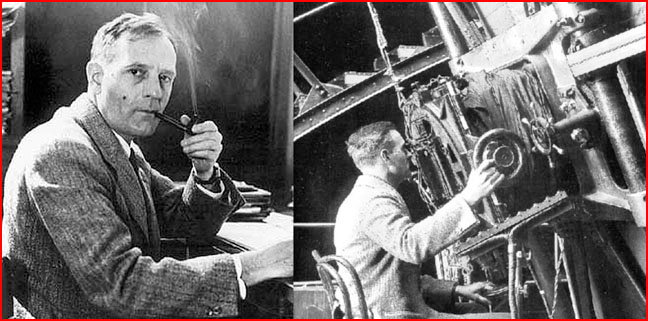
4a. Edwin Hubble and the realm of the galaxies In 1923-1924 Edwin Hubble (1889-1953) used the 100-inch Hooker7Telescope at Mt. Wilson Observatory to discover Cepheid variable stars in the Andromeda Galaxy (M31). This was the first direct indication the Andromeda Galaxy and others like it were separate from the Milky Way. With observation of Cepheid variable stars in M31, M33, and other nearby galaxies, Hubble ended forever the centuries old debate concerning whether the Milky Way was unique or whether there were other similar island universes (Belkora, 2003). Hubble also used the Cepheid period-luminosity relationship to estimate the distance to the Andromeda galaxy (M31). Hubble in one stroke proved the Universe extended far beyond the Milky Way, and he used Leavitt’s discovery to take a ruler to the extended Universe for the first time. Interestingly, up to this point Shapley had argued the Milky Way was unique, and there were no other galaxies similar to it.
Figure 8. Edwin Hubble. From: http://www.thunderbolts.info/tpod/2004/images/041109hubble-redshift.jpg We find our place in the Universe by using overlapping “yardsticks” to measure astronomical distances far and near. However, these yardsticks resemble a "house of cards." They are all based upon the preceding yardstick, and they are ultimately founded on having precise parallax measurements for the nearest objects. Parallax methods can directly measure the distance of objects “close” to the Earth, including Solar System objects and the nearest stars out to 300 + light years. Parallax measurements then support the use of stellar “standard candles” (Cepheid variable stars and RR Lyrae stars) on the next rung of the ladder for estimating more distant Milky Way objects and for measuring close by galaxies. Finally, very distant yardsticks (type 1a supernovae, spiral galaxy surface brightness fluctuations, and red shift determinations) are used for examining remote galaxy clusters and quasars (Ferdie, 2004). This house of cards technique of overlapping distance scales means we can take a ruler to the Universe, but it is fraught with uncertainty, and the errors add up as we extend our measurements to greater and greater distances. Cepheid variable stars are by far the most important second rung on our distance ladder. They are key to our measuring distances within our own Galaxy and its nearest neighbors. They are key for measuring distances throughout the Local Group, and they are the primary method for measuring distances to nearby galaxy clusters. Cepheid variable stars are also the foundation upon which modern estimates for the Hubble Constant are based (Ferdie, 2004). According to Schaeffer (2003), “…one of the most powerful tools in astronomy is the use of the Cepheid variable stars as distance indicators. The period of the star’s regular variation indicates its luminosity, which when coupled with the Cepheid’s apparent brightness yields its distance.”
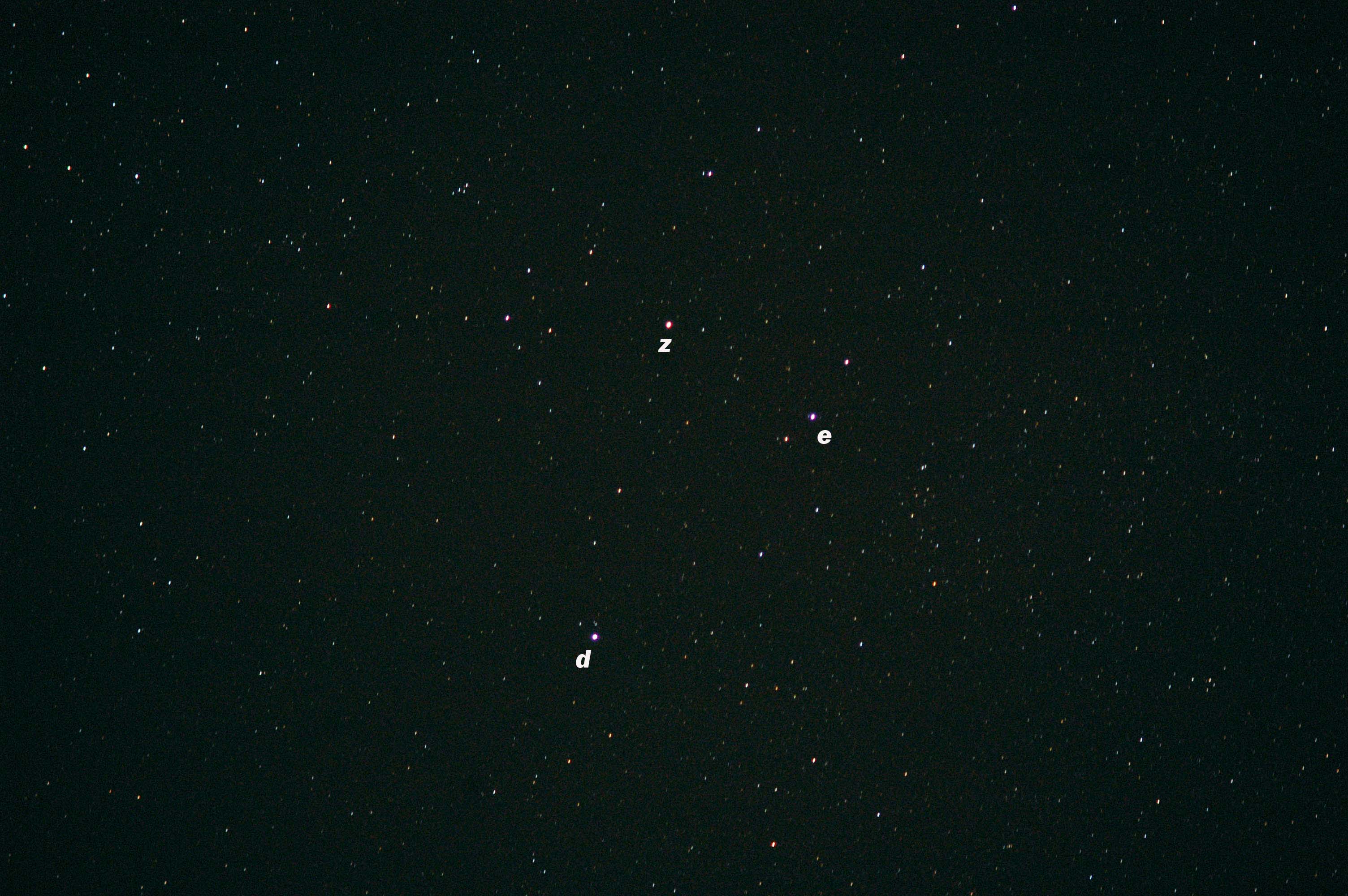
4b. Delta Cephei The prototype for the Cepheid variable stars is Delta Cephei (figure 9). It was listed by Hipparchus in his catalog and was given its designation as “Delta” Cephei by Johann Bayer (1572-1625) in his Uranometria first published in 1603. Its Flamsteed number is 27 after John Flamsteed’s (1646-1719) catalog published in 1725 (Moore, 2002). Delta Cephei is visible to the naked eye and varies from 3.48 to 4.37 magnitude over a period of 5.336 days. The Hipparcos Catalogue lists its parallax as 3.32 milliarcseconds (mas) which corresponds to a distance of 301 parsecs or 982 light years (SEDS; Hipparcos). John Goodricke (1764-1786) discovered its variability in 1784, though, interestingly it was actually the second Cepheid variable star to be discovered, the first being Eta Aquilae whose variability was noted by Edward Pigott (1753-1825) earlier in 1784. Delta Cephei is actually a double star with a 7th magnitude companion located 41 arcseconds away from it (AAVSO, 2000).
Figure 9. Delta Cephei and surroundings. The triangle of stars in the center of the image shows Delta Cephei (d), Epsilon Cephei (e), and Zeta Cephei (z) on 29 August 2005. Ten second exposure with Nikon D100 camera using a 135 mm f/2.8 lens, ISO 800. Delta Cephei is near maximum magnitude. tbh Considering Henrietta Leavitt’s deafness, it is ironic that John Goodricke became deaf at the age of 5 from scarlet fever. He was able to read lips and speak, because his parents were rich, and he had a good education in Scotland and England, excelling in mathematics and astronomy. Goodricke is particularly noted for his determination of the period of Algol, and he advanced a theory of Algol’s variability based on the concept the star was periodically occulted by a dark body, or it has a darker region which periodically rotates into view from the Earth. His observations were reported to the Royal Society in 1783, and he was awarded the Godfrey Copley medal. Goodricke’s exacting observations of Delta Cephei in 1784 led to a very accurate determination of its period of 128 hours 45 minutes (5 days, 8 hours, 45 minutes), very close to the modern value of 5 days 8 hours 37.5 minutes. Tragically, Goodricke died of pneumonia on April 20, 1786, four days after he had been admitted to the Royal Society. He was only 21 (Dengler, 2003). It may be an apocryphal story, but Goodricke is said to have caught his pneumonia after an evening of observing Delta Cephei. Edward Pigott along with his father
Nathaniel Pigott (1725-1804) is a noted figure in astronomical
history. He and his father lived in several places, including
England, France, and Wales. Together they observed transits of
Venus and comets. Edward Pigott started a campaign to expand
the count of variable stars and discovered several prominent
variable stars, including R Scuti, Eta Aquilae, and R Coronae
Borealis (AAVSO, 2002; Jones, 2002). Pigott is also known for
his discovery of a comet and along with Johan Bode (1749-1826)
is credited with the discovery of M64 (Jones, 2002). He
was a close friend, next door neighbor, and mentor of John
Goodricke. Pigott and Goodricke cooperated closely on their
observations (AAVSO; Jones, 2002).
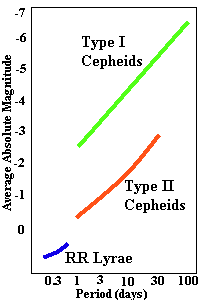
4c. Standard candles Cepheid variable stars are an important standard candle for determining distances to astronomical objects. Standard candles are the next rung on the distance ladder after parallax measurements. At this point, we leave direct measurement techniques and begin to extend our distance scale to millions of light years using indirect techniques. Standard candles represent any astronomical object with a consistent, well known intrinsic luminosity. The observed brightness of a standard candle in the Milky Way or in another galaxy can be compared with its known intrinsic brightness to estimate its distance. Cepheid variable stars, RR Lyrae stars, and type Ia supernovae are the classic standard candles. Cepheids variable stars are giant stars that regularly pulsate in size and brightness. They have individual periods between 1-100 days directly related to their intrinsic luminosities which vary between 500-300,000 times that of the Sun. Cepheids contain large amounts of helium. Their pulsations and brightness variations result from their very hot cores that are hot enough to doubly ionize the helium. Doubly ionized helium is relatively opaque to electromagnetic radiation emitted from the star's core. This energy is partially absobed by the helium containing layer dimming the star's apparent brightness. As the energy is absorbed by the doubly ionized helium layer, it expands this inner shell and the rest of the star external to it. This expansion cools the star permitting the helium to recapture lost electrons. The now singly ionized helium containing layer is more transparent to electromagnetic radiation brighening the star. As the star expands and brightens, it begins to lose increasing energy finally contracting on itself starting over the entire pulsation process which is known as the kappa mechanism (Tosteson, 2020). Cepheids variables are the most important stellar candles for short and intermediate astronomical distances out to 50-100 million light years. Type 1a supernovae are a particular type of supernova with a characteristic spectrum and light curve. Their peak luminosities are almost exactly the same, and they can be used as standard candles for measuring the most distant reaches of the Universe. Figure 10 compares the periods of Cepheid and RR Lyrae stars, and figure 11 shows the typical light curve for a classical Cepheid variable star.
Figure 10. Comparison of Cepheid and RR Lyrae stars.
Figure 11. Typical light curve for a Type I (Classical) Cepheid variable star. The period-luminosity (P-L) relation of Cepheid variable stars states that those Cepheids with longer periods have greater mean luminosity. The zero point of this relationship was defined as the absolute magnitude of a Cepheid variable with a period of one day. The work in the 1920’s and 1930’s seemed to indicate this value was 0.0; i.e., a Cepheid variable star with a period of one day has an absolute magnitude of 0.0. This belief was held until approximately 1950. By then, it had become apparent that the P-L relation needed major revision. RR Lyrae stars are periodic variable stars with periods under one day. Because of their regularity, they were assumed to follow the Cepheid P-L relation. However, Shapley and his colleagues could not detect any RR Lyrae stars in the Magellanic Clouds, even though they should have been detectable at the clouds then presumed distance of 100,000 light years. Also, Knut Lundmark (1889-1958) noted a discrepancy between the distance to M31 as estimated by the Cepheid P-L relation versus that derived from other methods, such as using ordinary nova brightness. Milky Way globular clusters contain large numbers of short period RR Lyrae variable stars. The distance and absolute magnitude of nearby RR Lyrae stars was estimated using their proper motions and spectral characteristics. The data for RR Lyrae stars was then used to estimate the distances to other Milky Way globular clusters. It was found that the largest and brightest globular clusters were similar to each other, and it was then assumed that the brightness of globular clusters could be used to estimate the distance to M31 using the data for its globular clusters. In 1948, when Lundmark compared the globular cluster brightness method with the novae brightness method, he found the two agreed with each other and gave a distance to M31 approximately twice as far as had been thought up to that time.
4d. Walter Baade and the doubling of the size of the Universe In 1941-1942, when Los Angeles was blacked at night during World War II, Walter Baade (1893-1960) was able to push the 100-inch Hooker telescope at Mt. Wilson to its limit, resolving the most luminous stars in the Andromeda Galaxy (M31). Baade classified the “metal rich,” bluer, brighter stars in M31’s spiral arms as Population I, and he classified the redder, older and somewhat less luminous stars in M31’s nuclear region and in its globular clusters as Population II stars. RR Lyrae stars belong to Population II and are not classical Cepheid variables. RR Lyrae stars are old, red giant stars with masses only between 0.5 and 0.8 of the Sun but with radii ~ 5 times that of the Sun (Sandage, 2000). They are near the end of their lives burning helium in their cores, producing a luminosity about 50 times that of the Sun. They are commonly found in galactic nuclei and are numerous in globular clusters. Cepheid variables on the other hand are massive helium burning stars with extreme luminosities up to 30,000 times that of the Sun. They are among the most luminous stars known. However, they are far less common than RR Lyrae stars, making both types of stars important for distance measurements (Sandage, 2000). Population I Cepheid variables (true or classical “Cepheids”) are about 1.5 magnitudes more luminous than Population II Cepheids. The true Cepheids have a heavier metal content and occur in the galactic disk, while the fainter type II Cepheids have similar periods but tend to occur in globular clusters and the galactic halo. It is important to distinguish between the two types of Cepheid variable stars because of their different intrinsic luminosities. When the Cepheids were thought to be all the same, the distance estimate to M31 was off by a factor of two; the distance to M31 had been derived by comparing the brighter Population I Cepheids in M31 with the somewhat dimmer Population II Cepheids in the Milky Way (Ferdie, 2004). After Baade recognized this problem in 1952, he calculated M31 was twice as far away as had been previously thought. Baade “doubled the size of the Universe” overnight! The two types of Cepheids are distinguished by their different spectra, their slightly different light curves, and their different characteristic locations. Shapley used brilliant work by himself and the earlier work by Ejnar Hertzsprung with statistical parallaxes to calibrate Leavitt’s period-apparent luminosity curve for the long period classical Cepheids in the Magellanic Clouds. He then used his estimated absolute magnitudes for the various long period Cepheids to measure the distances to those globular clusters which he felt contained long period Cepheids. The distances to these globular clusters thereby allowed Shapley to calibrate the RR Lyrae stars in the clusters. Shapley’s value for the absolute magnitude of all RR Lyrae stars was approximately ~ 0.0. This turns out to be nearly correct, though it is somewhat of a lucky guess. Some of Shapley’s assumptions were later found to be erroneous, but they produced mutually canceling effects (Ferdie, 2004; Sandage, 2000).
4e. Calibration of the Cepheid period-luminosity Calibration of standard candles is critical. It should be remembered that a zero point for adjusting the Cepheid variable “standard candle” was based on averaging estimated distances of nearer Cepheids. This means that if such distances need further adjustment, the distance scale for measurements to globular star clusters and galaxies would need to be shifted. Because of the limitations of ground based parallax measurements to provide an accurate picture of the stars around us, a satellite system was developed to measure parallaxes from space where the distortion of the Earth’s atmosphere would not interfere with the measurements. This would extend an accurate parallax distance scale out much further to more accurately map remote celestial objects. The European Space Agency (ESA) launched the High Precision Parallax Collecting Satellite (Hipparcos) in August 1989, and it ceased functioning in August 1993. Hipparcos was named for Hipparchus (190-120 B.C.) who compiled the first “precise” star catalog in antiquity. Hipparcos produced an incredible amount of data. The main Hipparcos Catalog has parallaxes and other information for 118,218 stars. Its precision is approximately 0.001 arc seconds. Distances to stars within 30 light years of the Sun are precise to 1% accuracy. Distances to stars out to 300 light years were measured with an error rate of 10% or less. Hipparcos also collected lower precision parallax data on 2.5 million stars, the Tycho-1 Catalog. Because of the success of Hipparcos, ESA and NASA have several parallax satellites on the drawing board to provide very precise parallax data on millions of stars out to distances of several thousand light years. Cepheids are quite rare, and not one of them was close enough to show a parallax before Hipparcos! Only a few of them were within Hipparcos’s outer reach. Thus, the Cepheid standard candle, the jumping off point for measuring the distances to remote galaxies, remains more uncertain than we would like, though there are many ongoing programs to examine Cepheids in the Milky Way, the Magellanic Clouds and nearby galaxies to ever better “standardize” this standard candle. The Hipparcos Catalogue lists the parallax of Delta Cephei as 3.32 milliarcseconds (mas) which corresponds to a distance of 301 parsecs or 982 light years. Recently, G. Fritz Benedict of MacDonald Observatory and eighteen other astronomers used one of the Hubble Space Telescope’s (HST) fine guidance sensors to obtain an even more accurate parallax distance for Delta Cephei of 3.66 ± 0.15 milliseconds or 890 ± 36 light years (Sky & Telescope December 2002, page 26). The work of Hubble, Baade, and others using the 100-inch Mt. Wilson telescope and then the 200-inch Mount Palomar telescope initially stretched the Cepheid “standard candle” measuring rod distance capability out to an estimated 3 million light years, encompassing about 20 galaxies in what is now known as the Local Group of galaxies. Today, using the HST we can monitor other galaxy Cepheid and RR Lyrae variables as well as other very bright stars in galaxies out to about a hundred million light years (Sky &Telescope February 2002, pages 18 – 19). However, it takes a great deal of observing time to make this type of measurement for each galaxy. In 1929, Hubble announced there is a basic linear relationship between a galaxy’s recessional velocity (as measured by its redshift) and its distance; the greater the distance, the greater the galaxy’s redshift. In 1931, Hubble and Milton Humason (1891-1972) erroneously determined the proportionality as 559 km/s/Mpc with a very naively stated uncertainty factor "of the area of ten percent." This proportionality would later be known as the Hubble constant (H0). The Hubble constant is the fundamental value used to estimate the age and size of the visible Universe. Its value has been refined with ever increasing complex observations since Hubble’s time.
5. The Hubble Space Telescope Key Project 5a. The factor of two controversy The Hubble Space Telescope’s Key Project to Measure the Hubble Constant was specifically designed to accurately measure the value of H0 to an accuracy of 10%. In fact, measuring the Hubble constant was one of the three major goals for the Hubble Space Telescope before it was launched in 1990. Until the Hubble Key Project was completed, H0 was uncertain to a factor of two with fiercely debated values ranging from 100 to 50 km/sec/Mpc. These values produced an age range for the Universe of 10 to 20 billion years. Moreover, the lower estimates for the age of the Universe were less than the estimated ages of the oldest stars in globular clusters! Obviously, there was some fundamental misunderstanding of stellar astrophysics and/or the proper value for H0. The HST was used to observe an initial 18 galaxies out to 65 million light years with added measurements of 13 more galaxies. Almost 800 Cepheid variable stars were found, and they were used to calibrate many different methods for estimating galactic distances. The initial data analysis produced a value for H0 of 70 km/sec/Mpc. This value has been slightly further modified to 72 +/- 8 km/s/Mpc, giving a rough estimate for the age of the Universe of ~13.8 billion years. Thus, the factor of two controversy was ended, and the Universe was fortunately found to be old enough to accommodate its oldest stars. Other measurements of the Hubble constant by the Wilkinson Microwave Anisotropy Probe (WMAP) using cosmic microwave background radiation and by the Chandra X-ray telescope give similar values ranging from ~ 71 to 77 km/sec/Mpc with an uncertainty of 15%.
6. Leavitt and her legacy Henrietta Leavitt’s 1908 discovery of the Period-Apparent Magnitude relationship for Cepheid variable stars is generally acknowledged as one of the most significant astronomical findings in the 20th century (Papacosta, 2004). Schaeffer (2003) goes so far as to state: “I rank this discovery among the top five in all astronomy in the last century.” In January 2009 at the American Astronomical Society (AAS) 213th meeting in Long Beach, CA, the AAS Council unanimously passed a resolution recognizing Henrietta Leavitt's contribution to astronomy: " The AAS Council recognizes the 100th anniversary of Henrietta Leavitt's first presentation of the Cepheid Period-Luminosity relation, a seminal discovery in astronomy that continues to have great significance. The Council was pleased to learn of a resolution adopted by the organizers of the Leavitt Symposium in which it was suggested that this important relation now be referred to as the 'Leavitt Law'. Although we recognize that the AAS has no authority to define astronomical nomenclature, we would be very pleased if this designation were used widely." Sadly, in 1925 Professor Gosta Mittag-Leffler (1846-1927)8 of the Swedish Academy of Sciences wrote to Leavitt concerning his intent to nominate her for the 1926 Nobel prize. According to Papacosta (2004; 2005), “…Harlow Shapley, the director of the Harvard Observatory, replied to professor Mittag's letter. In his letter, Shapley informed Mittag of the unfortunate death of Henrietta Leavitt and expressed his respect for her work. Shapley also acknowledged using the Period-Luminosity law for distance measurements in his early work.” Why didn’t Leavit push beyond her initial discovery? No one knows. Probably, her career reflects the difficult times for women astronomers in her era, and it probably reflects a combination of her shy, almost reclusive nature, and her fragile health. We will never know. Nevertheless, let us hope, Henrietta Leavitt can be more than a mere footnote in the history of astronomy, though being a footnote is far beyond what most persons achieve in their lifetime. Leavitt’s thoughts and desires have been lost in the fog of time. Most likely, she would be less worried about her fame and glory, than she would have been about the efforts of her labor being used to good purposes. In that regard, I think she would surely be pleased to see the results of her discovery one hundred years later being at the forefront of our efforts to understand the Universe. First Posted Friday August 10, 2007 First revision Saturday May 30, 2009 Second revision Friday March 14, 2014 Third revision Tuesday September 1, 2020
| Back | |References | |Table 1 |
The Hooker telescope is named for John D. Hooker, a Los Angeles businessman who donated $45,000 to cover the cost of the mirror. He wanted his named attached to the largest telescope ever built. Gosta Mittag-Leffler, a world famous mathematician, founded Acta Mathematica in 1882. He also had the finest mathematical library in the world. He and his wife bequeathed their library and estate at Djursholm, Sweden near Stockholm to the Swedish Academy of Sciences in 1916. The Mittag-Leffler Institute (http://www.mittag-leffler.se/) was set up based on his house and is a major mathematical research center.
|
||
 |
|||
Copyright © 2013 The Grasslands Observatory. All rights reserved. |
|||